
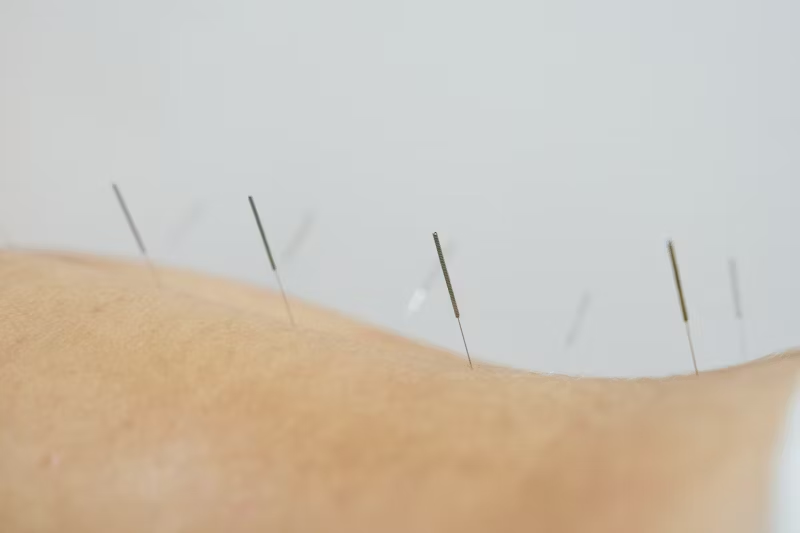
If you've been looking into ways to treat your pain, you've probably come across both dry needling and acupuncture. They might look similar at first, since both use thin needles, but they're actually very different in how and why they work.
At JointWorks PT, serving Northbridge and Ashland, MA, I use dry needling as part of my physical therapy treatment plans. Let's break down the key differences so you can decide which one might be right for you.
Where They Come From
Acupuncture is an ancient practice from traditional Chinese medicine, dating back over 2,500 years. It's based on the idea that energy ("qi") flows through pathways in your body. When that flow is blocked or out of balance, pain and illness can follow.
Dry Needling is a modern technique rooted in Western medicine. It's based on what we know about anatomy and pain science. The goal is to release tight, painful knots in your muscles: what therapists call trigger points. [1]
Treatment Goals and Approach
Acupuncture aims to restore energy flow by placing needles at specific points along the body's meridians. These points might not be anywhere near your pain. Practitioners also consider broader concepts like yin, yang, and the five elements.
Dry Needling goes straight to the source. The needle is placed directly into tight muscle bands or knots that are causing your pain or limiting your movement. The goal is to get a small twitch, which helps the muscle relax and work normally again. [2]
What the Evidence Actually Shows
I have a stake in this comparison, so I want to be careful to be fair rather than to flatter the thing I happen to sell.
Dry needling. Studies show it lowers muscle pain in the short term, and most people feel a difference quickly [3]. It works best as one part of a plan. The needle settles the muscle down, and the exercise that follows is what keeps it that way.
You will also read that dry needling breaks up tight tissue. What we can actually see is a quick twitch in the muscle when the needle reaches the right spot, along with measurable chemical changes around it [4]. That twitch is the sign I am looking for, and it usually lines up with the muscle easing off.
Acupuncture. It has a larger body of research than dry needling, and for several conditions it helps more than no treatment at all. If that is what you are looking for, it is a reasonable thing to try.
Both are reasonable options for muscular pain. The difference is what happens around the needle. I use it to open up a muscle so we can retrain it in the same visit, which is where the lasting change comes from.
Now here is what I will say with confidence, because it is the part I can actually stand behind. People walk out of my treatment room moving better than they walked in, regularly enough that I keep a needle in my hand. Short-term relief is real, it is often substantial, and when a muscle has been guarding for months, breaking that cycle for even a few days changes what is possible.
What I am careful about is the story I tell you about why. You deserve a clinician who knows the difference between what works and what we can prove about how, and who will not dress up a guess as a mechanism to sound more impressive.
The needle is also not the treatment. The plan is. That is the actual difference between needling here and needling at a place that puts needles in you for fifteen minutes and sends you home. The needle gets you out of the way of your own guarding. What you do next is what holds.
Who Performs Each Treatment?
Acupuncture is done by licensed acupuncturists trained in traditional Chinese medicine.
Dry Needling is done by healthcare providers like physical therapists, chiropractors, or doctors who have completed hands-on training in the technique. In Massachusetts, physical therapists like myself can use dry needling as part of your treatment plan.
Which One Is Right for You?
Both can help with pain, but the best choice depends on your condition, preferences, and goals:
Dry Needling might be appropriate if:
- You have tight, painful spots in your muscles
- You want it as part of a full physical therapy program
- You prefer an approach based on modern medicine
- You have trouble moving because of muscle tightness or pain
Acupuncture might be appropriate if:
- You want a whole-body approach to overall wellness
- You have conditions that may respond well to traditional Chinese medicine
- You're looking for help beyond muscle and joint pain
- You prefer a treatment with centuries of history behind it
My Approach to Dry Needling at JointWorks PT
As a physical therapist with advanced training in hands-on care, I use dry needling as one tool in a bigger treatment plan. When patients come to JointWorks PT with muscle pain or limited movement, I do a thorough check to see if dry needling could help.
Needling is never the whole plan. If a needle gets a muscle to let go, that is the moment to retrain how it works, and the exercise that follows is what stops it seizing up again. Needling on its own tends to buy you a few good days and then you are back where you started.
I also want to be clear about when I stop. If two or three sessions of needling have not changed anything for you, it is not working, and continuing to needle you would be me charging you for a preference rather than a result. We would change the plan.
Experience the Difference
If you are trying to decide between the two, the practical question is not which has better science. It is what else comes with it. Dry needling with me sits inside a physical therapy plan with an exam, hands-on work, and an exercise progression. Acupuncture sits inside a different tradition with its own framework. Pick the package that fits what you are actually after.
And if you have had good results from acupuncture, keep going. I am not trying to talk you out of something that is working for you.
References
- Espejo-Antunez L et al. Dry needling in the management of myofascial trigger points: A systematic review of randomized controlled trials. PMID 28735825. PubMed
- Gattie E et al. The Effectiveness of Trigger Point Dry Needling for Musculoskeletal Conditions by Physical Therapists: A Systematic Review and Meta-analysis. PMID 28158962. PubMed
- Dunning J et al. Dry needling versus acupuncture: the ongoing debate. PMID 26546163. PubMed
- Tough EA et al. Acupuncture and dry needling in the management of myofascial trigger point pain: a systematic review and meta-analysis of randomised controlled trials. PMID 18395479. PubMed
This article is for general education and is not medical advice. Dry needling is not appropriate for everyone. Talk with your own care team before starting any new treatment.