
Here is a pattern I saw for years in the clinic. Someone starts strong, comes twice a week, makes real progress. Then work gets busy or a kid gets sick, they miss a session, then two, and the plan quietly falls apart. Not because the treatment stopped working. Because getting there stopped being possible.
In-home physical therapy exists to remove that failure point. I drive to Ashland, Northbridge, and the towns around them, and I bring the session with me.
What Is In-Home Physical Therapy?
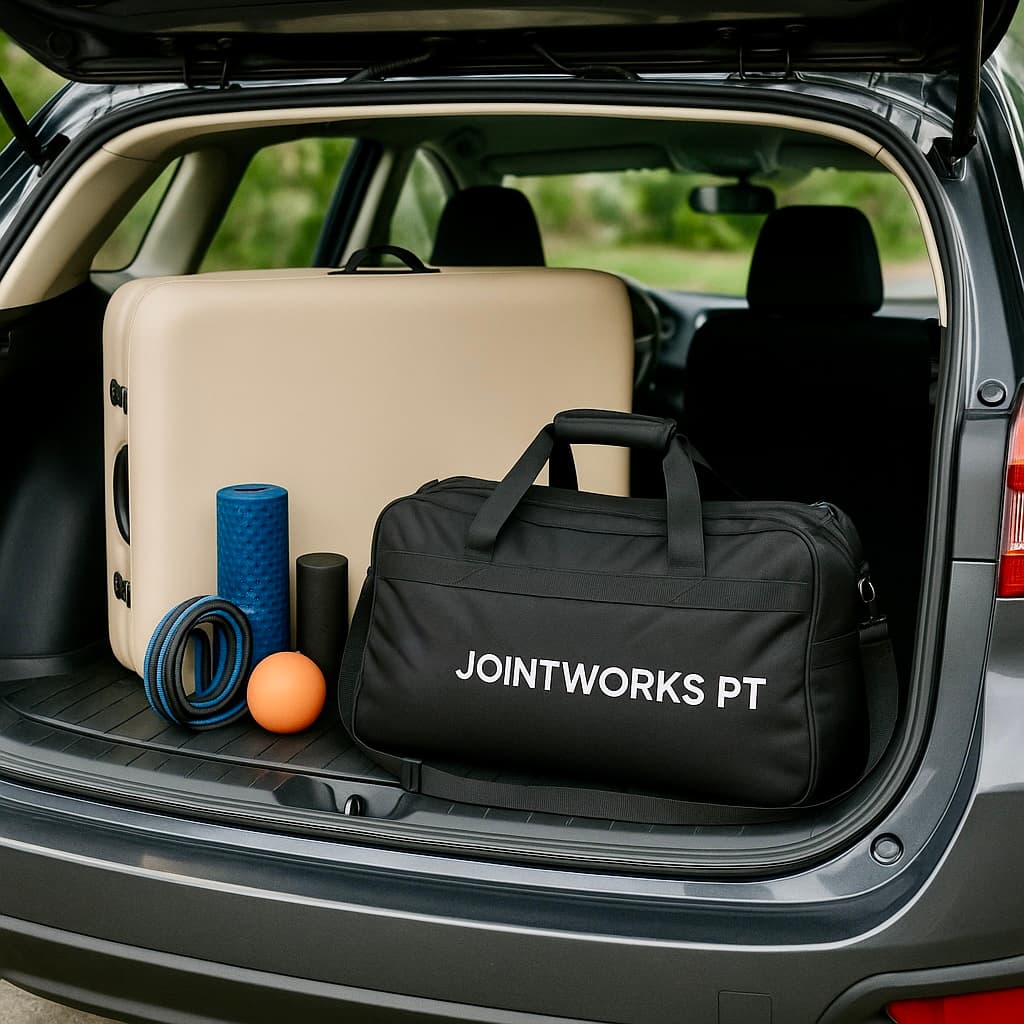
I arrive with a treatment table and everything else a session needs: hands-on work, exercise coaching, dry needling, cupping. It is the same hour you would get in the clinic, in your living room.
Every session includes:
- Full movement assessment
- Hands-on therapy techniques
- Targeted exercises with coaching
- Dry needling, cupping, and soft-tissue work
- Real-world movement and workspace check
- A custom exercise plan to do on your own
What the research supports is that home-based rehab produces results comparable to clinic-based care for a range of conditions [1]. Comparable, not superior. The argument for coming to you is not that my hands work better in your kitchen. It is that a session you actually attend beats a better session you skip.
Who Can Benefit from In-Home Physical Therapy?
In-home care is worth paying for when getting to a clinic is the thing most likely to derail your recovery. That is a narrower group than the marketing usually suggests. It tends to fit:
- Busy professionals: Executives, entrepreneurs, and remote workers
- Parents: Those managing childcare and home responsibilities
- Post-surgical patients: Recovering safely with limited mobility
- Older adults: Who prefer or need to stay home
- Chronic pain patients: Managing ongoing conditions comfortably
- Anyone seeking convenience: Who values private, one-on-one care
If none of that describes you and the clinic is a ten-minute drive, come to the clinic. You will get the same care and you will not pay for my travel.
What Equipment Do I Bring to Home Visits?
I bring a portable setup that covers nearly everything the clinic does, including the handheld ultrasound. The one real limit is heavy strength equipment, and if your plan needs it, we do that part in the clinic.
Equipment Includes:
- Full-size professional treatment table
- Resistance bands, weights, and balance tools
- Hands-on therapy tools for soft-tissue work
- Dry-needling and cupping supplies
- Assessment tools for range of motion, posture, and strength
I set up and pack down. You need a space about the size of a yoga mat and somewhere to put the table.
How Is In-Home PT Different from Telehealth?
Both are convenient and give you expert guidance, but in-home PT includes full hands-on treatment and techniques that can't be done over video.
Key Differences:
- Manual therapy: Full hands-on care in-person
- Advanced equipment: Dry needling, cupping, mobilization tools
- Comprehensive testing: Strength and movement assessments
- Real-world insight: Evaluate posture, ergonomics, and movement at home
- No tech required: No cameras, log-ins, or connectivity issues
Telehealth is the cheaper and more flexible option, and for some problems it is genuinely enough [2]. If what you mainly need is coaching and progression on an exercise program, do not pay me to drive. In-home earns its cost when hands-on treatment is a real part of the plan.
Areas Served
JointWorks PT provides in-home physical therapy throughout Central Massachusetts and the MetroWest region, including:
- Northbridge
- Ashland
- Mendon & Douglas
- Framingham & Holliston
- Hopkinton & Milford
- And surrounding communities across the Blackstone Valley and MetroWest area
If you're unsure whether your location is covered, just reach out. We'll confirm availability and travel radius.
How Long Are In-Home PT Sessions?
Each session lasts a full hour and follows the same structure as a clinic visit: assessment, hands-on treatment, exercises, and education.
Typical Structure:
- Assessment (10-15 min): Review progress and mobility
- Manual therapy (20-25 min): Soft-tissue and joint techniques
- Exercise (15-20 min): Strength, balance, and functional training
- Education (5-10 min): Home program and recovery tips
You'll receive the same focused, one-on-one care, only in your own home.
Insurance and Payment Options
JointWorks PT is a cash-based practice, which means you're in charge of your care. We give you superbills to submit to your insurance for possible out-of-network reimbursement.
Payment Options:
- Credit, debit, cash, or HSA/FSA cards
- Transparent, upfront pricing: no hidden fees
- Superbills provided upon request
How to Prepare for Your Session
Preparation is simple: I bring everything else.
Checklist:
- Wear comfortable clothing for movement.
- Clear 6-8 feet of open space.
- Have any relevant imaging or reports available.
- Write down any questions or goals you'd like to discuss.
Is In-Home PT as Effective as Clinic Visits?
Home-based rehab tends to produce outcomes comparable to clinic-based care, not better ones. [3] What home genuinely adds is context. I see the actual stairs you struggle with, the chair you push out of twenty times a day, the side of the bed you roll toward. That changes what I prescribe in a way a clinic visit cannot.
Unique Advantages:
- Real-world movement assessment
- Ergonomic evaluation of home and work setups
- Practical, space-specific exercise planning
- Optional caregiver or family involvement
- Total comfort and privacy
In-home care turns therapy from something you go to into something that fits naturally into your life. [4]
What You Are Actually Paying For
In-home care costs more than a clinic visit, because part of what you are buying is my drive time. That is worth naming plainly rather than dressing up as a lifestyle upgrade.
Each visit is:
- One-on-one: 100% of your therapist's attention
- Thorough: Full range of treatment options
- Same standard: The exam, the hands-on work, and the plan are identical to the clinic
- Convenient: No traffic, no waiting rooms, no stress
- Practical: Delivered in the environment where you live, move, and heal
Bring Your Recovery Home
If getting to appointments is the part of recovery you keep losing to, that is a solvable problem, and it is worth solving before it derails a plan that would otherwise work.
Schedule a free consultation and tell me where you are. I will be straight with you about whether coming to you is worth the difference in cost for your situation.
References
- Stolee P et al. Inpatient versus home-based rehabilitation for older adults with musculoskeletal disorders: a systematic review. PMID 21971753. PubMed
- Calvert MJ et al. Home-based physical therapy results in similar outcomes to formal outpatient physical therapy after reverse total shoulder arthroplasty: a randomized controlled trial. PMID 37178958. PubMed
- Bell MJ et al. Improvements following short term home based physical and functional therapy are maintained at one year in people with moderate to severe rheumatoid arthritis. PMID 11196519. PubMed
- Hush JM et al. Patient satisfaction with musculoskeletal physical therapy care: a systematic review. PMID 21071504. PubMed
This article is for general education and is not medical advice. Talk with your own care team about what setting is right for your situation.